


in climate action
invested in companies with decarbonization targets
in climate solutions
Our 2025–2030 Climate Strategy
In 2017, La Caisse was one of the first institutional investors to adopt a climate policy, which was enhanced in 2021, covering its entire portfolio. Since then, La Caisse’s climate discipline has paid off: our portfolio has decarbonized faster than anticipated, and we exceeded our targets. This is why, in June 2025, we introduced a new phase in our climate strategy to accelerate the decarbonization of companies and the economy. We now aim to have $400 billion invested in climate action by 2030.
With its climate action, La Caisse seeks to generate optimal returns while supporting the real economy’s transition toward a more resilient, low-carbon future. This ambitious approach enables us to continue seizing new investment opportunities in the context of the energy transition and increase our contribution to the decarbonization of the real economy. The portfolio’s decarbonization is therefore the result of decarbonizing the companies held in it, rather than a consequence of having prioritized investments in low-intensity sectors.
As at December 31, 2025, La Caisse’s climate action investments totalled $226 billion, including $38 billion in Québec, compared with $158 billion at the end of 2024, an increase of $68 billion.
Changes in our climate action (in $B)
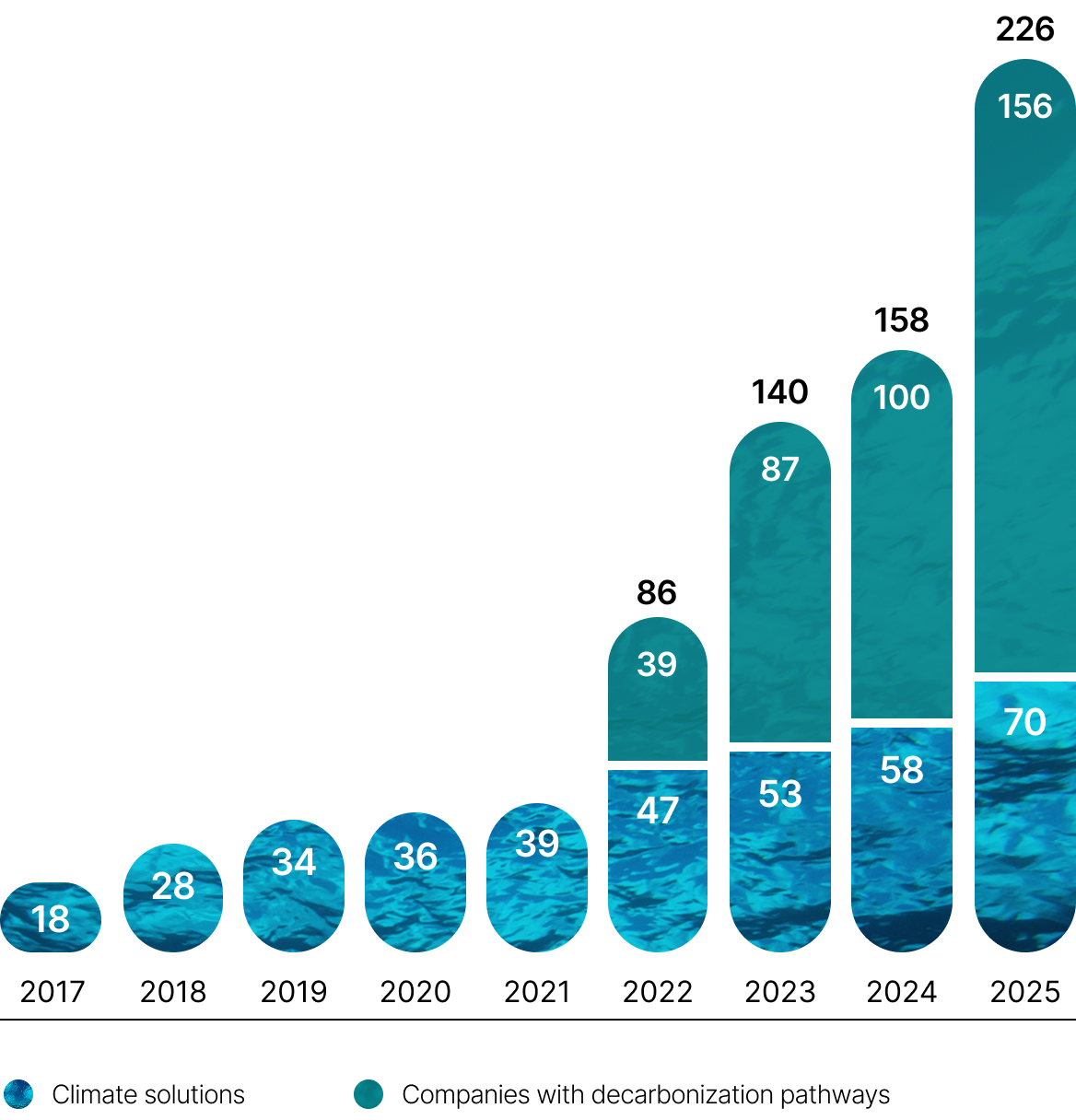
For 2025, the chart shows new low-carbon investments, transition assets, and assets aligned with or in the process of being aligned with the Paris Agreement, based on the classifications in effect as at December 31, 2024 ($40 billion). It also includes assets qualified under the new categories of the 2025–2030 climate strategy ($28 billion).
Two pillars to support our ambition
We make sure that our portfolio companies are advantageously positioned to seize opportunities and manage risks related to the transition.
01
Investing infuture-orientedclimatesolutions

- Activities promoting thetransition to low-carbonenergy and solutions
- Activities that enhance communityand business resilienceto climate change
- Nature-based activities and solutionsgenerating positive impacts on bothclimate and biodiversity
- Activities that facilitate or formpart of the goods and servicesmentioned above
02
Investing to support companies that integrate the climate into their business models and that adopt clear decarbonization pathways
- The most climate-maturecompanies with detailedand credible plansto reduce GHG emissionsin the medium term,tailored to their sectoraland geographic context
The keys to our success
- Climate risk management
- Proactive engagement with companies
- Ongoing dialogue with governments, regulators and civil society
- Variable compensation for all senior personnel, including the Executive Committee, linked to the achievement of our target and the implementation of our strategy
Credible approach
La Caisse’s rigorous approach is set out in our Transition Financing Framework. This has been endorsed by the Climate Bonds Initiative (CBI) and is based on global best practices established by the Science Based Targets initiative (SBTi), the Net Zero Investment Framework (NZIF) and the Transition Pathway Initiative (TPI).
Ongoing effort
Since our new climate strategy was launched in June 2025, teams at La Caisse have been working to finalize the methodologies and tools required for its implementation. They also began assessing part of the portfolio using the strategy’s new categories, work that is ongoing in 2026.
Investing in future-oriented climate solutions
We invest in companies, activities and technologies that contribute to the reduction of carbon emissions and belong to one of the four categories opposite.
Furthermore, in 2025, we updated our reference framework for green bonds to remain compliant with the principles of the International Capital Market Association (ICMA) and market best practices, thereby enabling the use of funds for investments that generate environmental impacts aligned with the climate solutions set out in our 2025–2030 climate strategy.
- Investments in sectors or activities that help strengthen communities’ resilience to climate change
- Includes equipment for water storage and flood prevention, and investments to strengthen the electrical grid or provide protection against extreme heat
As at December 31, 2025, this category had not been used in assessing La Caisse’s portfolio. This work will be carried out in 2026.
- Solutions that use natural ecosystems to address climate and biodiversity challenges
- Includes, notably, certain investments under our sustainable land management mandate in the Infrastructure portfolio, which are focused on deploying capital in land assets that deliver long-term positive impacts on the environment, climate and biodiversity
As at December 31, 2025, the value of these assets had reached $1.2 billion.
- Products or services that play a key role in achieving the objectives of the transition to a sustainable, resilient or low-carbon economy
- Includes manufacturing or installing batteries for renewable energy generation sites, water-efficient irrigation systems required for sustainable agriculture, and equipment designed to enhance resilience
As at December 31, 2025, the value of these assets had reached $4.1 billion.
Favouring and supporting companies undergoing decarbonization
We are helping accelerate the transition in Québec and around the world by:
- Leveraging our teams’ expertise to support our portfolio companies as they seize opportunities related to the transition and adopt or strengthen decarbonization targets
- Investing in less climate-mature industries and companies to support them as they reduce their carbon footprints
- Investing in companies that have a proactive climate strategy
Investing in decarbonization
As a long-term investor, La Caisse considers a company's future decarbonization pathways rather than the level of its historical emissions. Investments that qualify for the “decarbonization” component of La Caisse’s climate action are companies that have a net-zero ambition and have set themselves, depending on their sectoral and geographic context, medium-term decarbonization targets, while respecting the principle of a just transition.
Our methodology classifies the level of ambition of these targets into three tiers:
- Committed: Interim targets that are rigorous and credible but not aligned with the Paris Agreement
- Aligning: Rigorous, science-based interim targets
- Fully aligned: Science-based interim targets accompanied by a credible roadmap or external certification
To assess the quality of these companies’ transition plans, we draw on globally recognized best practices as described in La Caisse’s Climate Transition Framework.
Climate maturity of our portfolio companies (in $B)


Carbon intensity
Changes in the carbon intensity of our portfolio are not linear, and its trajectory, both downward and upward, may be affected by various factors, such as asset valuations or investment opportunities.
In 2021, we raised the portfolio’s carbon intensity reduction target to 60% by 2030, compared with 2017, in line with our goal of carbon neutrality by 2050. In the same year, we created a transition envelope to invest in companies with higher emissions but also ambitious and credible decarbonization plans.
We previously disclosed the carbon footprint of our transition envelope separately, alongside the anticipated decarbonization pathways of the companies within it. Beginning this year, as part of our new climate strategy, we are considering these assets as fully aligned. Their carbon footprint is therefore included in the total portfolio's.
As at December 31, 2025, the portfolio’s carbon intensity, including the transition envelope, stood at 28.4 tCO2e/M$, down 64% since 2017. On a comparable basis with 2024 (excluding the transition envelope), the portfolio’s carbon intensity fell by 70% compared with 2017.
Changes in the portfolio’s carbon intensity (in tCO2e/M$) since 2017
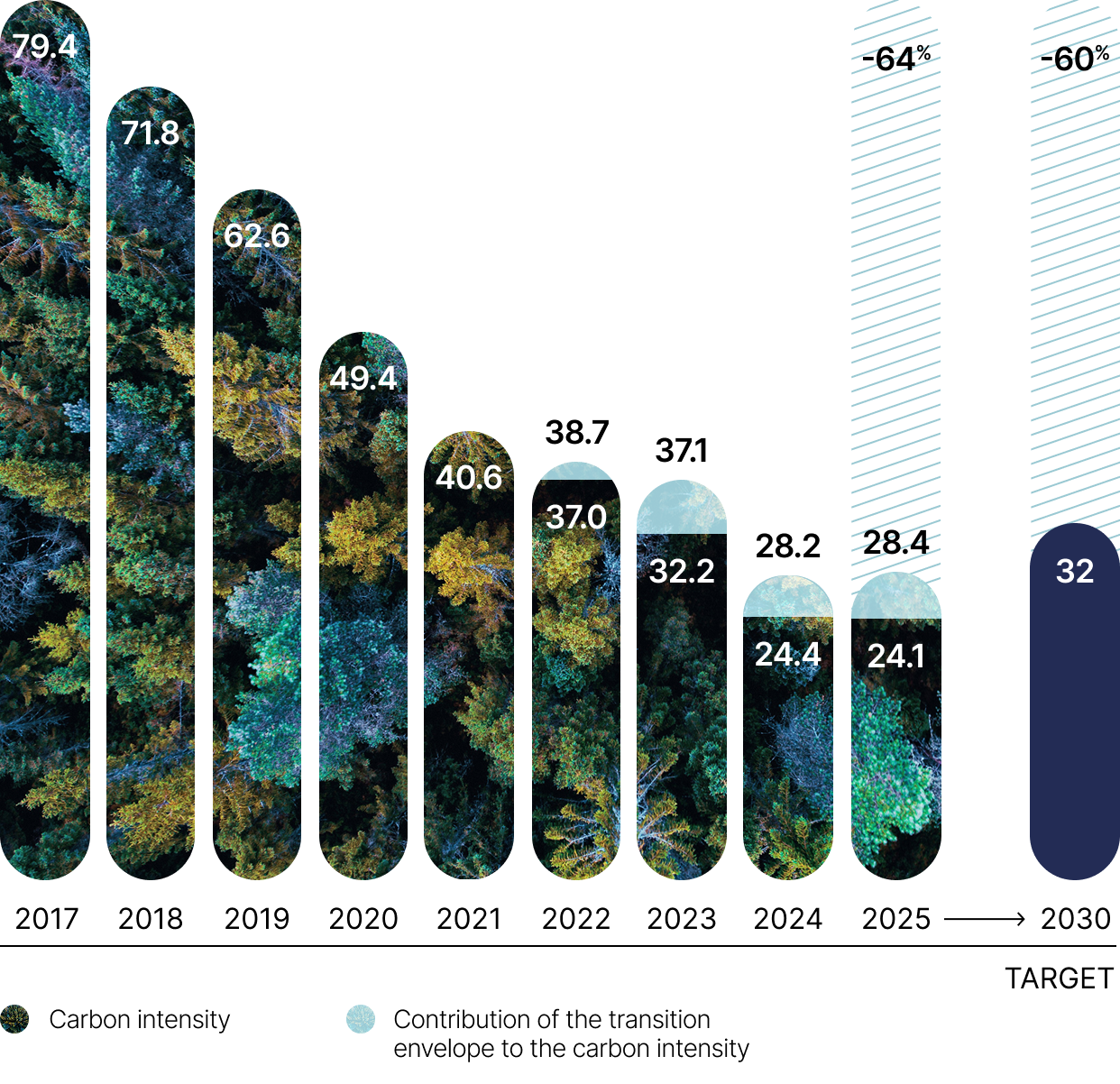
Since 2025, the transition envelope has been included in the calculation of the portfolio’s carbon intensity.
Perimeter for calculating the carbon footprint in dollars invested and in CO2 emissions
Carbon footprint
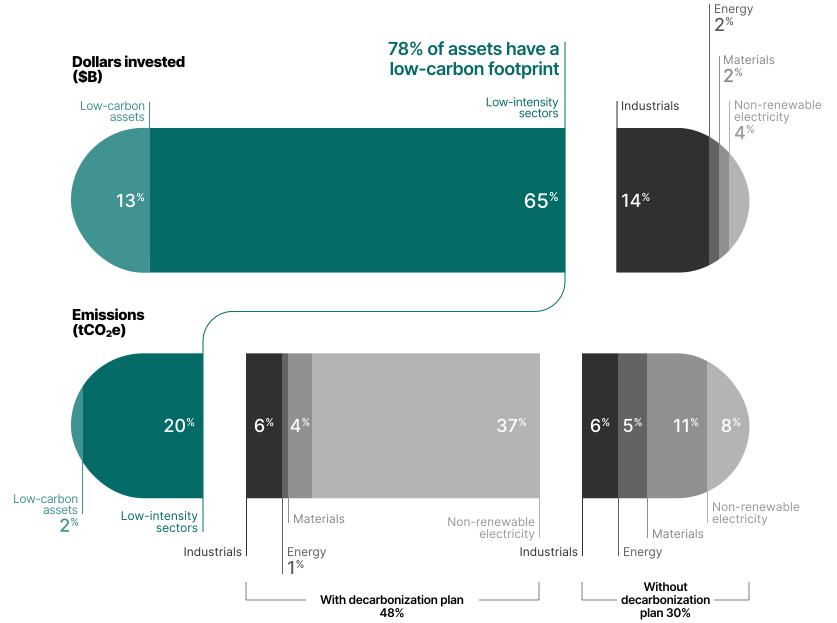
La Caisse’s carbon footprint reflects the balance between low-carbon assets and key transition sectors.
Our carbon footprint calculation perimeter ($498 billion) comprises investments in sectors with wide ranging levels of greenhouse gas (GHG) emissions.
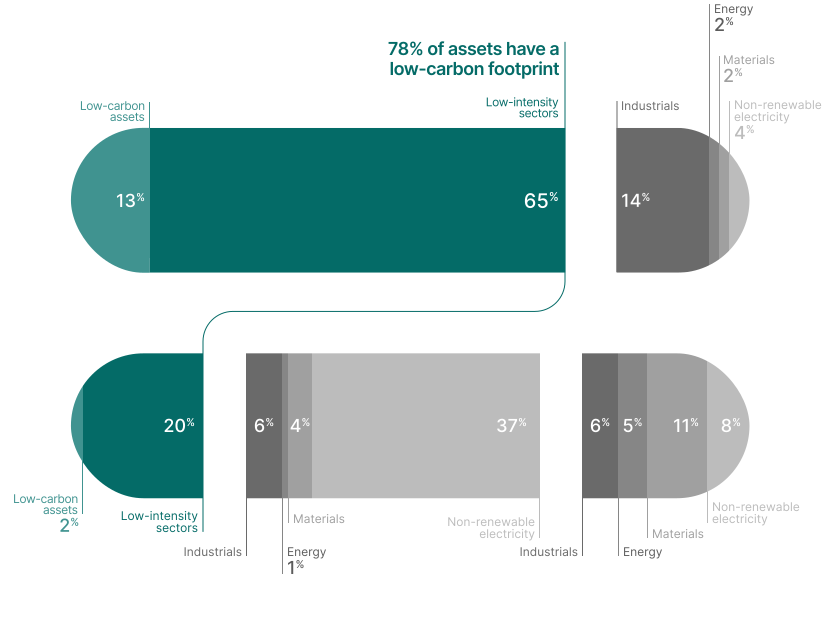
At the end of 2025, 78% of our portfolio consisted of low-carbon assets or investments in low-intensity sectors, amounting to over $380 billion in investments.
The remainder of our portfolio includes assets from sectors essential to the transition, such as energy generation, industrials (transportation, construction) and materials (Chart 6), and they account for the majority of our total footprint. We support companies in these sectors as they decarbonize their activities. We encourage them to improve their practices and to adopt ambitious and rigorous GHG reduction plans. As at December 31, 2025, nearly one in two companies had a decarbonization plan in place.
Diverse energy sources to support the transition
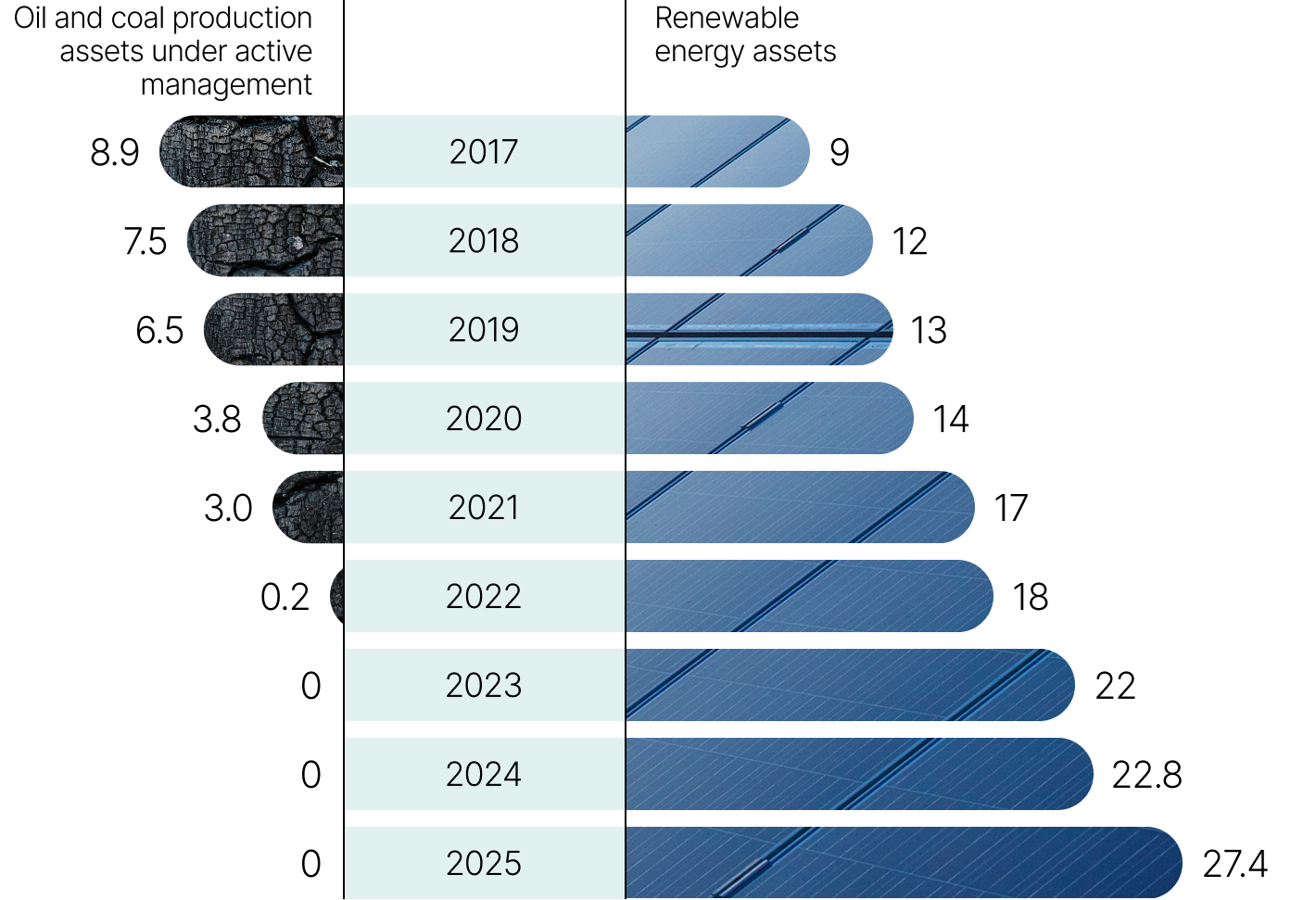
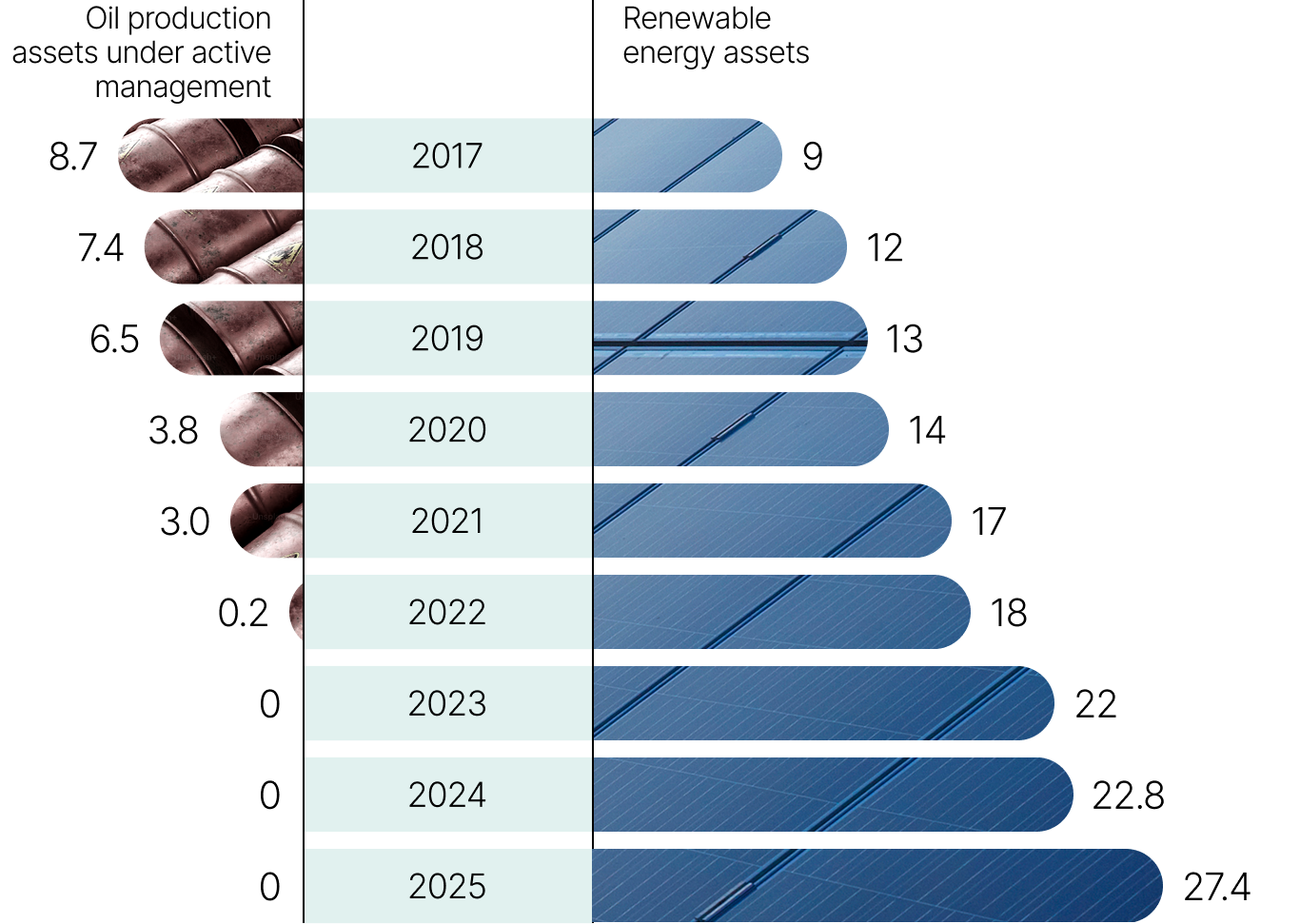
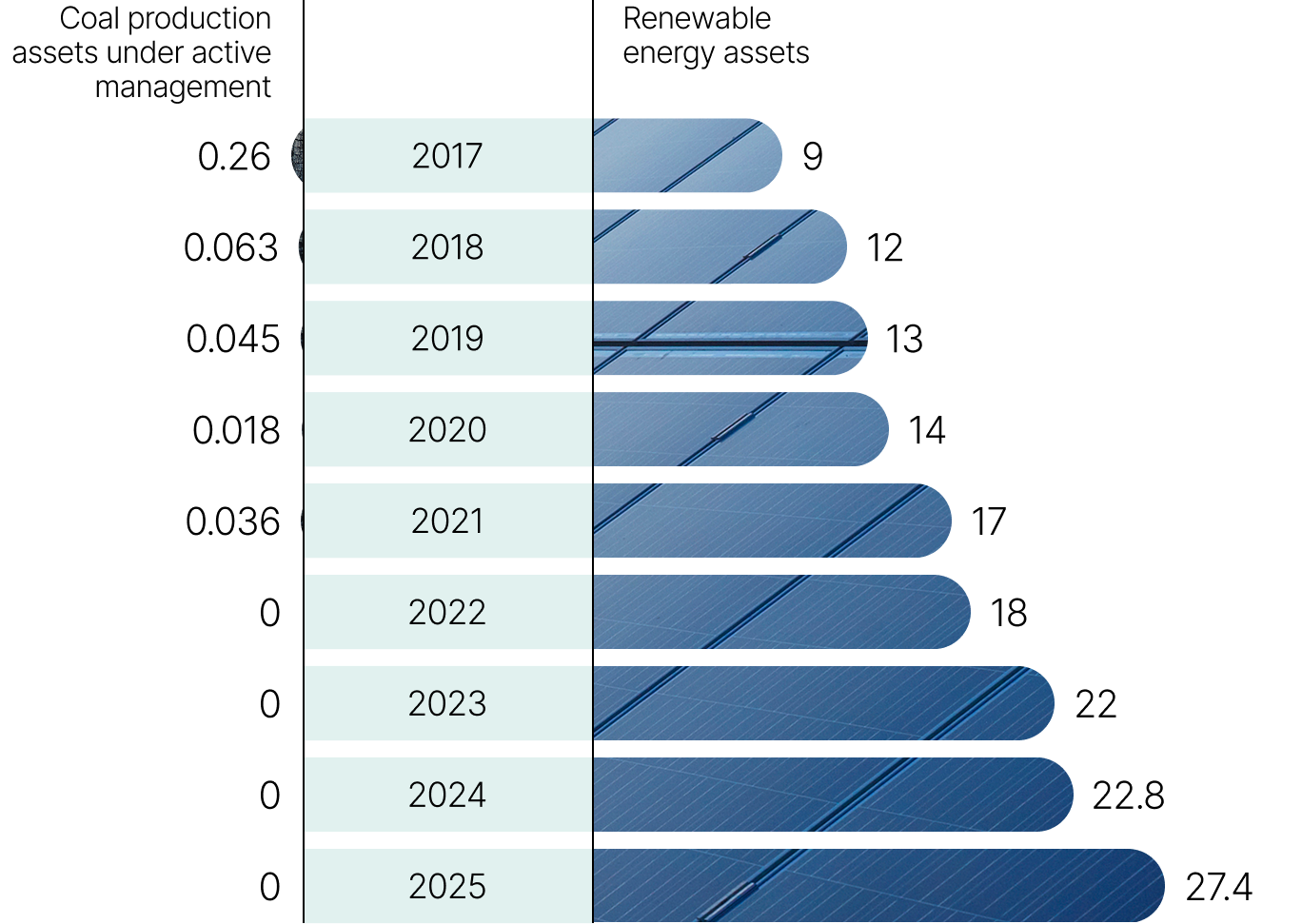
La Caisse exited thermal coal mining and oil production at the end of 2023. The exclusion of these two sectors, which no longer align with our long-term investment objectives, continues to be part of our new climate strategy.
Natural gas, meanwhile, remains an energy source that is necessary for the transition, as a complement to renewable energies. In this sector, our investments are mostly in gas transportation infrastructure, with these assets accounting for 1.4% of our portfolio.
Investments in renewable energy assets make up a significant portion of our total portfolio and continue to grow. At the end of 2025, these assets represented 5.5% of our portfolio.
Renewable energy assets represent a significant portion of our portfolio, while oil and coal production is now excluded (in $B)
Integrating biodiversity
La Caisse adopts an integrated approach that takes sustainability factors into account at every stage of the investment process. Nature and biodiversity are an integral part of our practices.
In the infrastructure and real estate sectors, biodiversity issues are analyzed from the project design stage and throughout the project’s operating life cycle. Since 2024, the teams have had a dedicated tool for monitoring and assessing these issues. For investments in public markets, we focus our efforts on the sectors most dependent on nature or that have a significant impact on it. Where relevant, we dialogue through collaborative engagement initiatives, such as Nature Action 100, Spring and Farm Animal Investment Risk and Return (FAIRR). These initiatives enable us to amplify our influence and support companies in their efforts to protect nature.
In Québec, we have worked with Fondaction and the Société pour la nature et les parcs (SNAP Québec) to develop biodiversity indicators tailored to the province’s specific circumstances.
Capital to protect biodiversity
We pay particular attention to issues of deforestation and serious damage inflicted on nature. We also invest in natural capital, with a target of deploying $2 billion by the end of 2026. This milestone was reached in 2025. Of this amount, $1.2 billion is classified as climate action (see Nature-based solutions). These investments help protect biodiversity and support La Caisse’s climate action, in particular through carbon capture or reduced carbon emissions.